

 No. 1819, Renmin West Road, Cao'e Street, Shangyu District, Shaoxing City, Zhejiang Province, China

 English
 中文简体
中文简体 русский
 Español
 عربى
عربى
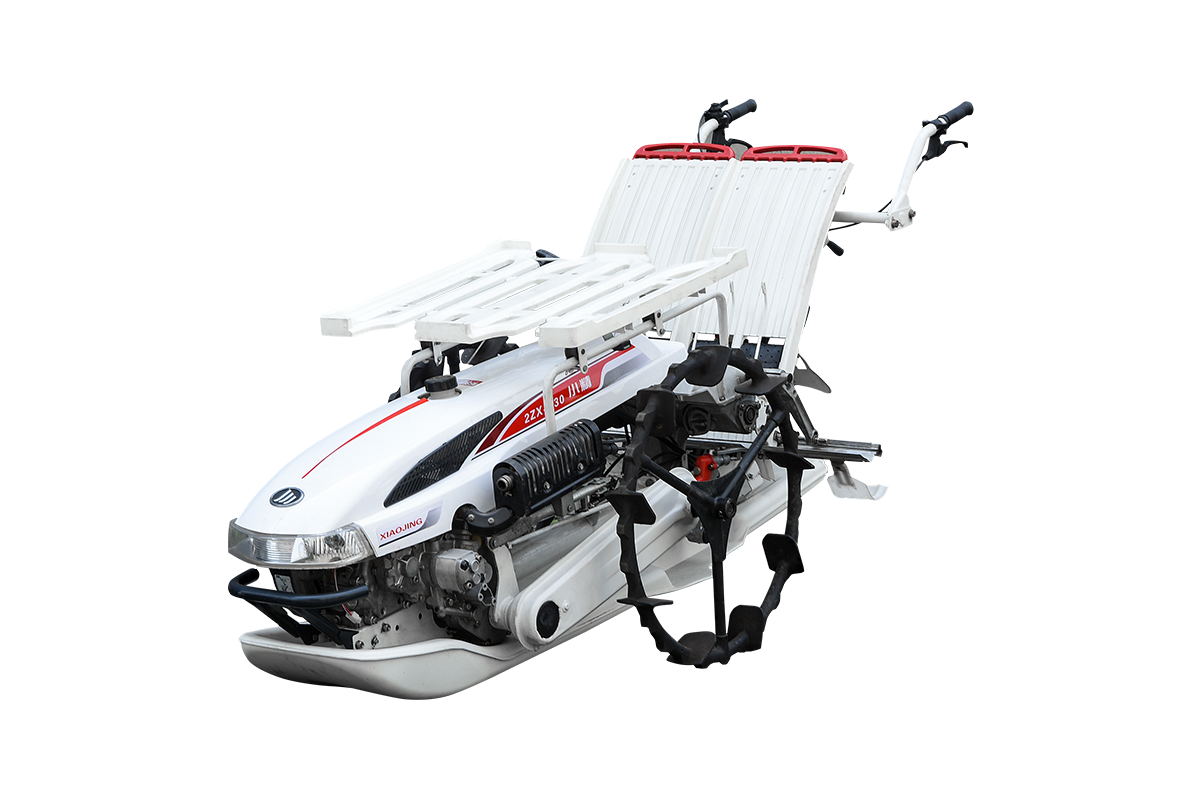
The 2ZX-230 two-row small low-fuel consumption hand-held transplanter is a high-performance machine ...

 2026.08.10
 Industry News
Japan transplants more than 98 percent of its rice paddies by machine. Behind that figure is a mechanical process few people ever examine: how does a transplanter turn a carpet of nursery seedlings into neat, evenly spaced rows? This guide answers that question at the component level. It is not a list of benefits; it walks through the machine, action by action, so you can picture exactly what happens in the field and know what to compare when you evaluate different models.
A rice transplanter is a specialized machine built to plant rice seedlings into flooded paddy fields. It is not a seeder and not a general-purpose planter. It exists because rice grows best when seedlings are raised in a nursery, then transplanted into the main field at controlled depth and spacing.
The concept is old; Japan filed its first rice transplanter patent in 1898. Practical machines, however, took decades to develop because they need to handle live plant material, soft mud, and precise timing all at once.
Manual transplanting is accurate but slow. One worker plants about 700 square meters per day by hand; a machine covers about 10,000 square meters per day, according to the comparison published on Wikipedia. Consistency is the second gain. A machine repeats the same stroke without tiring, so rows stay straight and depth stays uniform. Uniform spacing gives every plant equal access to sunlight, water, and nutrients, and it simplifies weeding and harvesting.
Put simply, a rice transplanter is an automated system that takes a continuous mat of seedlings, separates it into individual plants, and replants them in soil at fixed intervals.
Each cycle runs through four steps in sequence:
Chains and gears driven by the ground wheel synchronize all four steps. Because the mechanism is tied to wheel rotation, seedlings are planted at intervals that match forward travel, which keeps spacing even even at different speeds.
Five components do nearly all of the work. Here is what each one does and why it matters.
The seedling tray is an inclined platform that holds the nursery mat. The mat itself is a dense carpet of rice seedlings grown in shallow soil, with roots knitted into a cohesive layer. This mat-type nursery is the standard input for modern transplanters, and its condition directly controls output quality.
The tray indexer moves the mat the way a typewriter carriage moves paper: a short lateral step after several planting strokes, then a forward step when the lateral row is finished. That intermittent movement ensures the pickup forks always find fresh mat. When the indexer is mistimed, the field shows skips where the forks found nothing, or bunched plants where they pulled too much at once.
The pickup forks, often called fingers, remove the seedlings from the mat. Their motion is essentially a pinch. The forks close over a section of mat, dip slightly below the root zone, and pull out a discrete clump of two to four seedlings, which they then carry upward to the planting arm.
The critical adjustment is fork penetration depth. Set too deep, the forks drag up a clod of soil that can jam the mechanism and bury the seedling. Set too shallow, the roots are not gripped firmly, and seedlings drop out during transfer. Experienced operators judge this by inspecting the mat surface after the forks pass: it should look evenly scratched, not torn.
The planting arm receives the seedling clump from the forks, swings down on a fixed trajectory, presses the clump into the mud, and releases it at the bottom of the stroke. Release timing decides the outcome. Too early, the seedlings float back up; too late, the arm drags them along the soil surface.
The trajectory itself may be straight or slightly inclined. Straight insertion gives very uniform depth. A slight incline can keep the root zone shallower and promote earlier tillering in certain soils. The ideal angle depends on local practice and variety, so many machines allow adjustment. A detailed breakdown of the transplanting mechanism is available for readers who want to study the cams and timing in depth.
The float is a smooth, boat-like plate that rides directly on the mud surface. It supports the machine's weight so the wheels do not sink into soft paddy soil, and it smooths the mud as the machine advances. Its vertical position also defines the reference plane for planting depth.
The ground wheel powers everything. As it turns, a chain-and-gear train drives the tray indexer, pickup forks, and planting arm. This is why one engine can run the whole machine, and why planting density does not change when engine speed fluctuates. Planting rate is a function of wheel revolutions, not engine RPMs.
Three settings shape the final planting pattern:
The table below summarizes the controls.
| Parameter | Controlled by | Practical effect |
|---|---|---|
| Row spacing | Number and spacing of planting arms | Determines rows per pass and overall working width |
| Hill spacing | Gear ratio between ground wheel and planting mechanism | Widens or narrows the distance between plant clusters within a row |
| Planting depth | Float height and pickup fork penetration | Sets how deep the seedling root zone is placed |
Varieties and regions differ in their ideal density. High-tillering varieties grown in fertile soil can be planted wider, while short-duration varieties and cooler regions usually need denser stands. Adjustable hill spacing is therefore a feature to verify before purchase, and the adjustment range differs between models.
The working principle is identical in walking and riding machines. Both feed a mat, pinch seedlings with forks, and press them into the mud with a planting arm. The differences are scale, power delivery, and operator position.
Walking-type machines typically plant four to six rows per pass. The operator walks behind, steering while the engine drives the wheels and the planting mechanism. Their narrow width and light weight make them easy to turn at the headland and simple to transport. A four-row walking rice transplanter is the usual entry point for small plots, and a six-row walking rice transplanter adds output per pass without leaving the walking category.
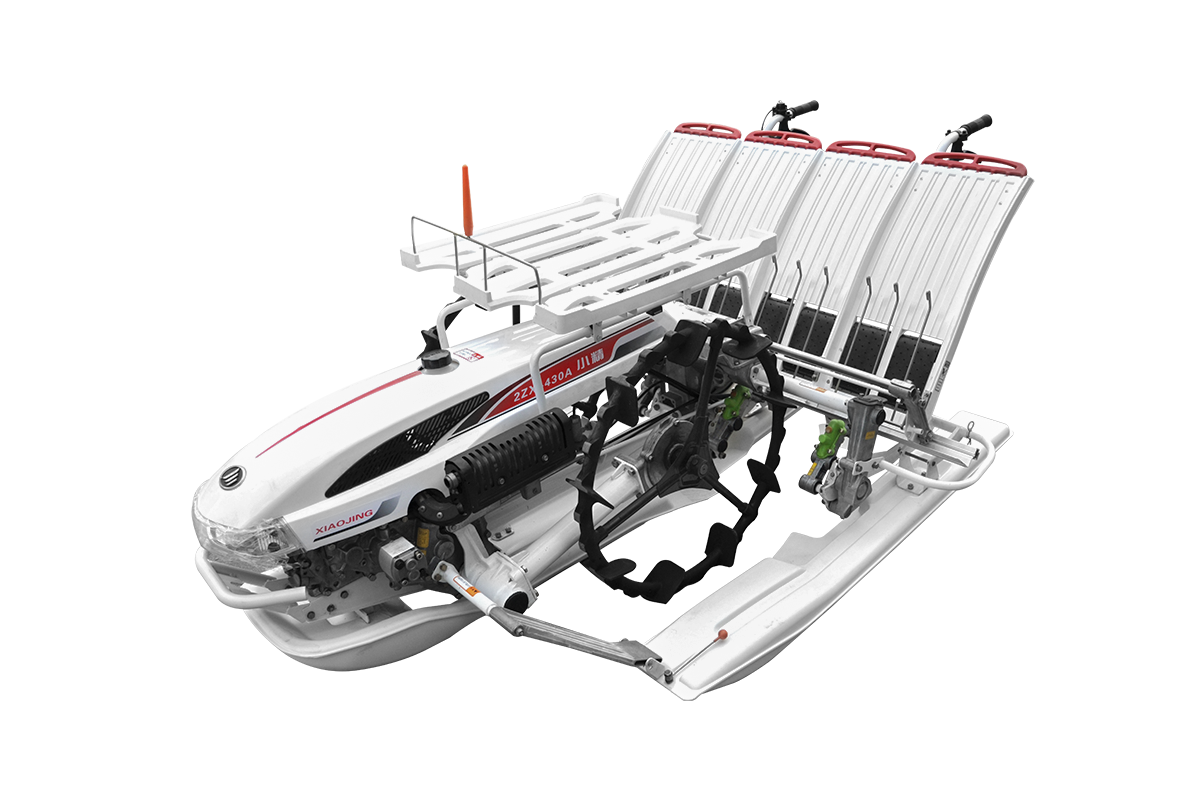 Custom 4 Row Rice Transplanter Manufacturers, SuppliersAs China 4 Row Rice Transplanter Manufacturers and Suppliers, Xiaojing Agricultural Machinery Manufacturing Co., Ltd. provide custom 4 Ro...View Product →
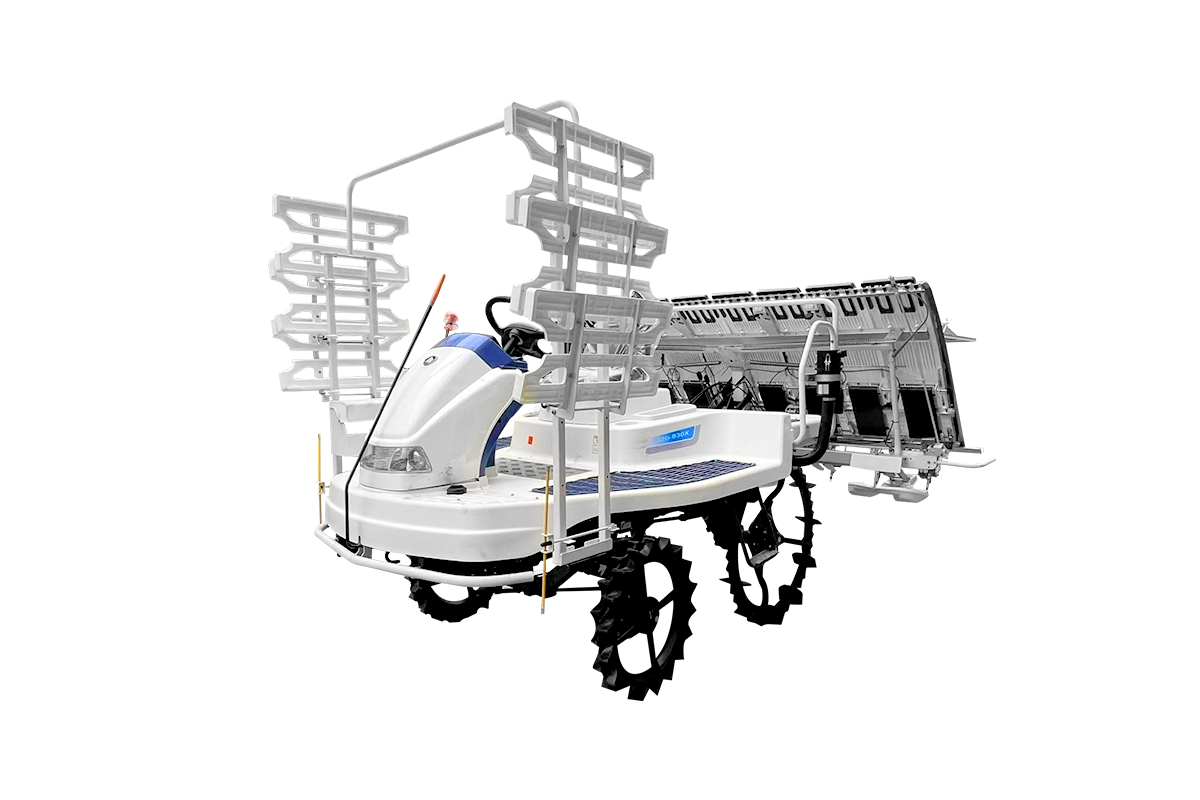
Riding-type machines are built for larger fields. The operator sits on the machine, which is fully self-propelled and typically plants six to ten rows per pass. Hydraulics lift the planting unit for transport and adjust the wheel track to match row spacing, and the seated position cuts fatigue during long working days. A six-row riding-type rice transplanter is the common next step after a farm has outgrown walking machines.
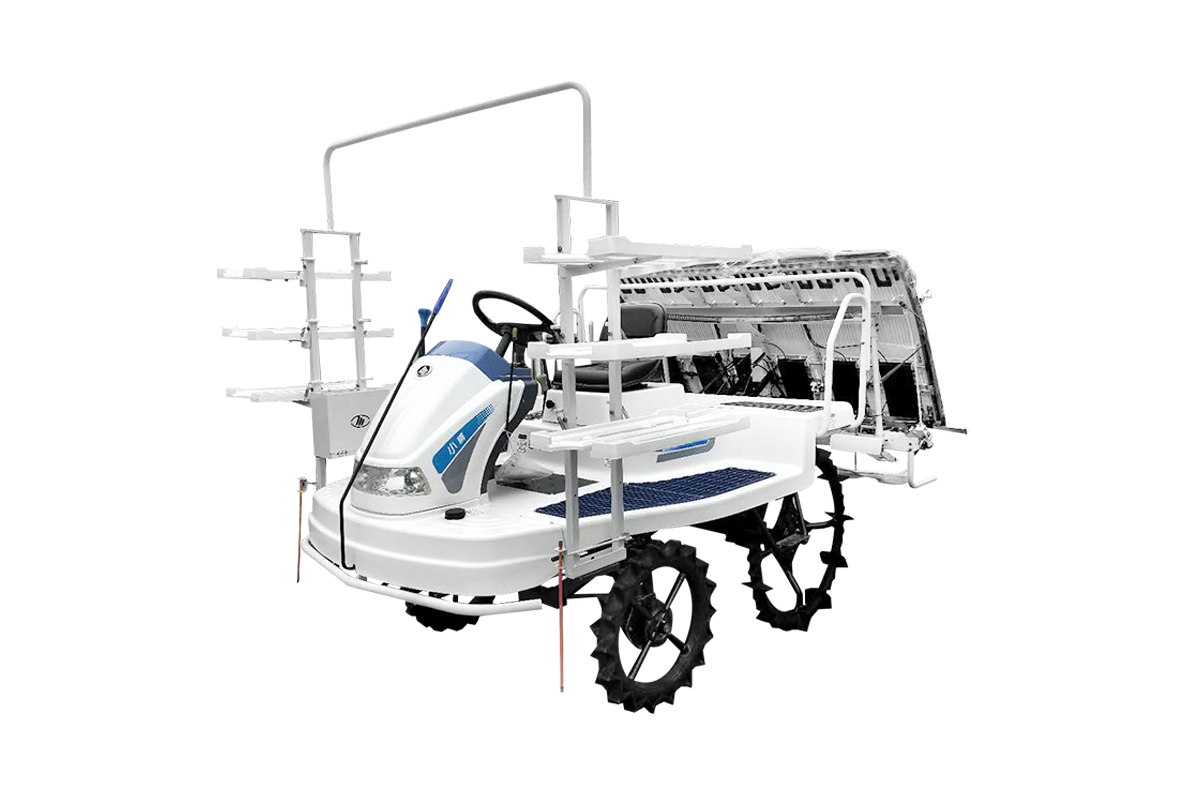 Custom 2ZG-630 Six-row Riding Type Rice Transplanter Suppliers, OEM/ODM FactoryZhejiang Xiaojing Agricultural Machnery Manufacturing Co., Ltd is China 2ZG-630 Six-row Riding Type Rice Transplanter Suppliers and OEM ...View Product →
| Feature | Walking-type | Riding-type |
|---|---|---|
| Typical rows per pass | 4 to 6 | 6 to 10 |
| Operator position | Walks behind, steering | Seated on the machine |
| Hydraulic systems | Minimal or none | Power lift, track adjustment |
| Best suited to | Small, irregular fields | Medium to large consolidated fields |
| Purchase and maintenance cost | Lower | Higher |
The core mechanism is the same; what changes is power and operator comfort. That is exactly why the walking-versus-riding decision comes down to field size, labor, and budget, not to any difference in how the rice is planted.
If transplanting is so laborious, why not sow seed directly? Direct seeding does save labor and is used in many places where workers are scarce. But it trades convenience for a less controlled crop start. Seeds land at variable depth, germination is uneven, and the stand is irregular. Wikipedia's overview of rice transplanting makes the point directly: some farmers outside Asia prefer the fuss-free direct-seeding method, often at the expense of reduced yield.
Transplanting gives each seedling a uniform start at equivalent depth and spacing, which supports even tillering, better airflow through the canopy, and more straightforward water and weed management. The transplanter does not change the agronomy; it removes the one big disadvantage of transplanting, which is the demand for hand labor. Once the machine covers that labor, the agronomic benefits become affordable at almost any farm scale.
With the mechanism understood, the purchase decision becomes a matching exercise. Consider four factors.
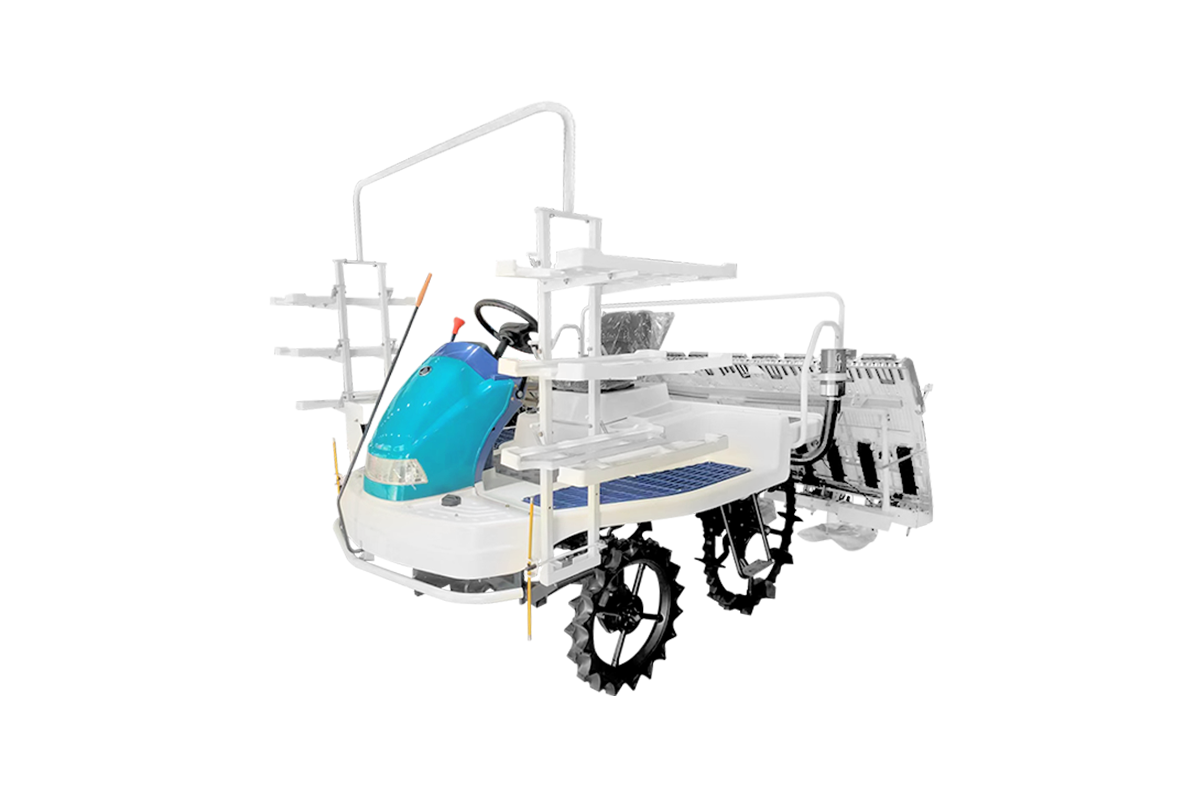 Custom 2ZG-1020 Ten Rows Riding Type Rice Transplanter Suppliers, OEM/ODM FactoZhejiang Xiaojing Agricultural Machnery Manufacturing Co., Ltd is China 2ZG-1020 Ten Rows Riding Type Rice Transplanter Suppliers and OE...View Product → is a credible candidate.
The manufacturer's range covers this spectrum, from 2-row handheld models to 10-row high-speed riding machines. When you compare specific models, look at the features that drive performance: tray indexer behavior, fork depth adjustment, planting arm timing, and the synchronization between ground wheel and planting mechanism.
A rice transplanter is not a mysterious machine. A tray feeds a mat of seedlings forward; pickup forks pinch off small clumps; a planting arm presses each clump into the mud; a float keeps the machine from sinking; and a ground wheel drives every action with fixed timing.
That timing is the real secret. Because the planting mechanism is coupled to the ground wheel, the machine plants by ratio, not by guesswork. Wheel turn, fork pinch, arm drop, release, repeated at a constant rate per meter of travel, creates the even rows you see in mechanically planted fields.
Whether you run one small plot or a large operation, the principle is the same. The only remaining question is scale, and that question is answered by your land, your labor, and your budget.


 Custom Agricultural Equipment Manufacturers