

 No. 1819, Renmin West Road, Cao'e Street, Shangyu District, Shaoxing City, Zhejiang Province, China

 English
 中文简体
中文简体 русский
 Español
 عربى
عربى
The 2ZX-230 two-row small low-fuel consumption hand-held transplanter is a high-performance machine ...

 2026.10.05
 Industry News
Last spring a grower with six hectares of paddy laid three quotations side by side on a folding table. One was for a two-row handheld machine, one for a four-row walking type, and one for an eight-row riding machine. The cheapest unit he could pay for in cash the same day. The most expensive one needed a deposit and a co-signer. He wanted to know which one was "the best," because every dealer he had spoken to claimed that theirs was.
Here is the straight answer: the best rice transplanter machine is the one whose row count, walking or riding configuration, chassis type and seedling pickup mechanism match your field shape, your soil bearing capacity, your seedling calendar and the number of workers you can actually keep on the farm during the planting window. A machine that is mismatched to those four variables is an expensive ornament. A machine that matches them, even a small handheld unit, pays for itself in a single or second season.
Everything below follows that logic in a fixed order. We look at field size first, then row count, then walking versus riding, then soil and mud depth, then cost and labour, and finally the specific mistakes that turn a good purchase into a bad one.
Answer those four and the shortlist almost writes itself. The rest of this article explains how each answer narrows the field.
Before going into detail, use this table as a first filter. It reflects the pattern that holds across most rice-growing regions, from Southeast Asia to West Africa and South America. Read the left column, find the line that describes your farm, and note the recommended configuration on the right.
| Field Condition | Best Configuration | Typical Row Count | Reason |
|---|---|---|---|
| Terraced, irregular or fragmented plots under 0.5 ha each | Handheld or small walking type | 2 rows | Can be carried between plots; no headland turning space required |
| 0.5 to 3 ha, soft puddled soil, family labour | Walking type, self-propelled | 4 to 6 rows | Balances purchase price against daily output |
| 3 to 20 ha, flat and consolidated blocks | Riding type, mechanical transmission | 6 to 8 rows | Operator stays seated; output is three to five times a handheld unit |
| Over 20 ha or contract planting services | Riding type, high-speed | 8 to 10 rows | Lowest cost per hectare; fastest completion of the planting window |
| Dry, sandy or direct-seeded fields | Rice seeder rather than transplanter | Not applicable | Transplanters need puddled, settled soil to hold seedling depth |
| Mixed rice and vegetable rotation | Transplanter plus a separate vegetable transplanter | 2 rows for vegetables | Different seedling geometry and planting depth requirements |
Note the last two rows carefully. Many buyers try to force a rice transplanter to do a job it was never designed for, then blame the machine. A rice transplanter places mat-type or pot-type rice seedlings into puddled soil at a controlled depth. If your field is dry and you are broadcasting or drilling seed, you want a seeder, not a transplanter.
Row count is the single specification that changes your daily output, your labour requirement and your turning losses more than any other. It also determines how much headland you need at each end of the field, which is the hidden cost that catches buyers off guard.
Think about what happens at the end of every pass. The operator lifts the planting unit, turns, realigns and lowers it again. That manoeuvre consumes time and, on badly matched fields, it consumes a surprising amount of it. A two-row machine turns in a tight arc and needs almost no headland. A ten-row riding machine needs a wide, firm headland, and if your plot is only 30 metres wide, you will spend more time turning than planting.
One more factor sits underneath row count: row spacing. Most rice transplanters use a fixed row spacing in the range of 25 to 30 centimetres, with hill spacing adjustable within a set of standard positions. If your local agronomy recommendation calls for a specific plant population per square metre, check that the available hill spacing settings can actually deliver it. A machine that cannot reach your target density will cost you yield regardless of how fast it drives.
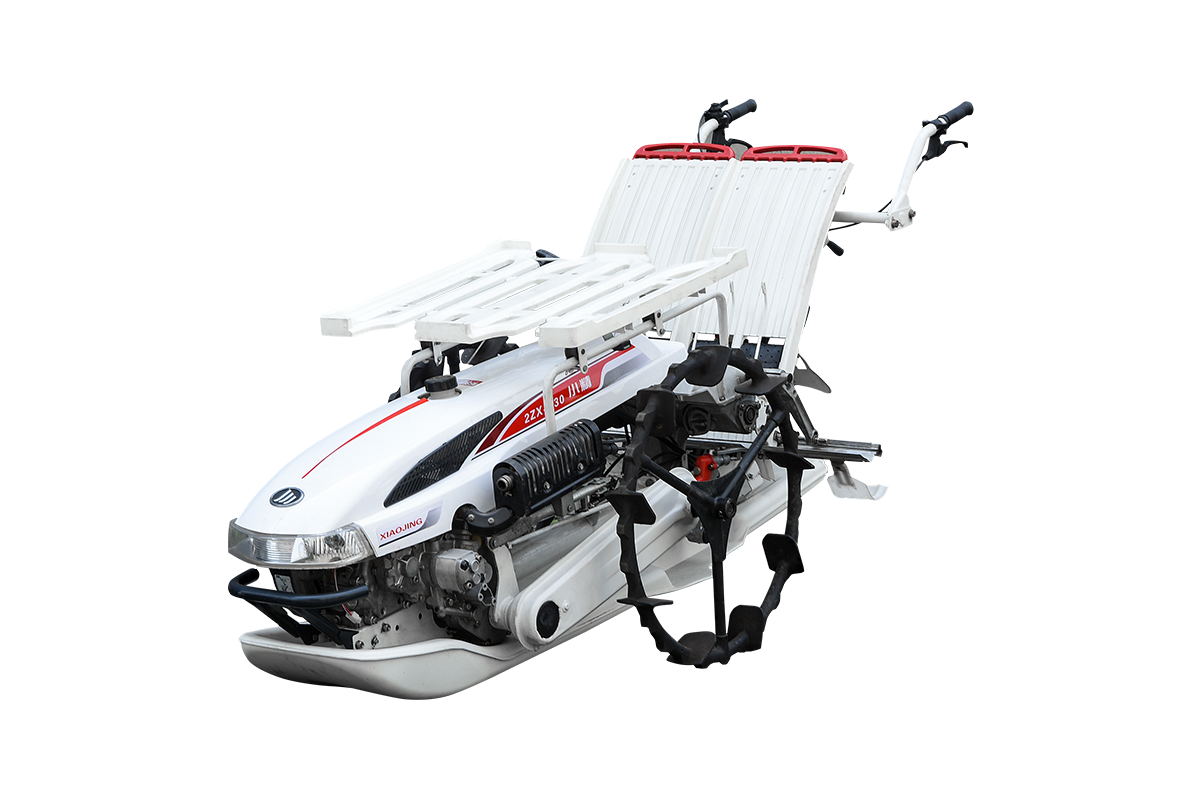
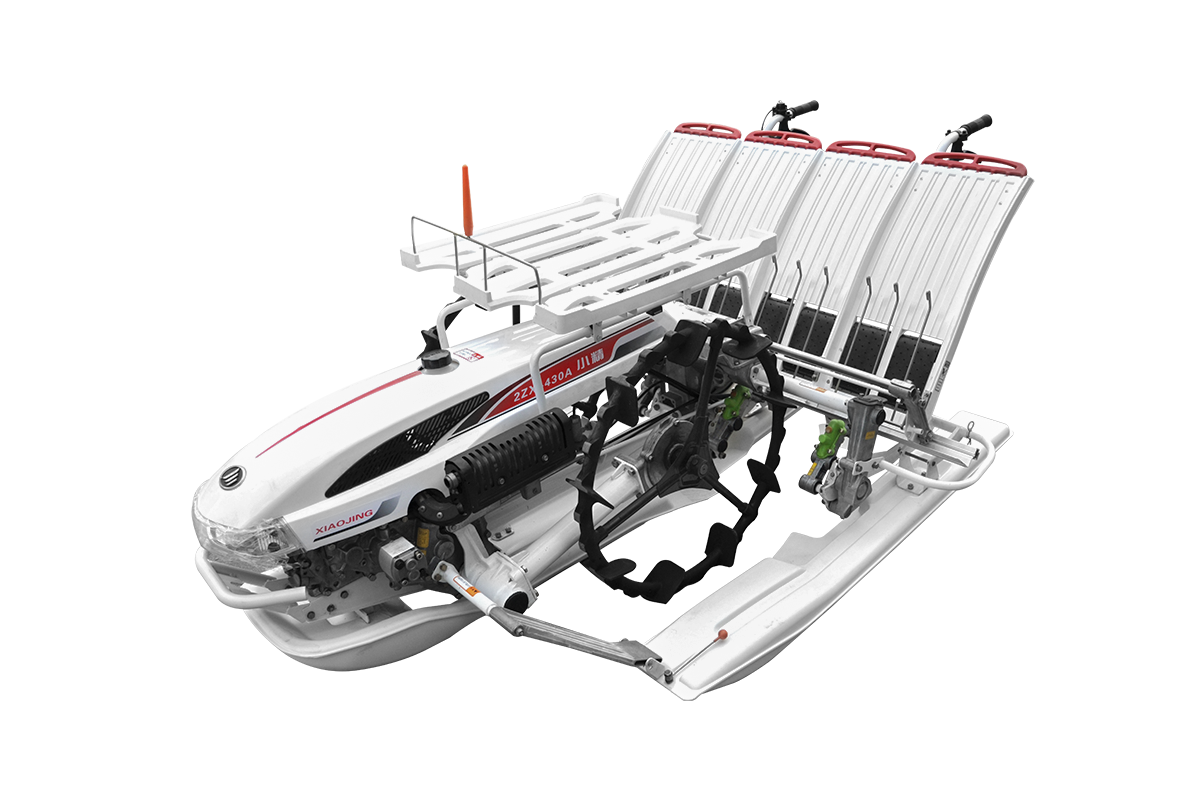
Walking machines are self-propelled but unseated. The operator walks behind the unit, guiding it with handlebars. They are lighter, cheaper, easier to transport between plots, and far more forgiving of soft ground than riding machines of the same row count.
Walking transplanters are the right answer when your plots are small, when the mud is deep enough that a heavier machine would sink, when you need to move the equipment between scattered fields on a small trailer, or when your budget does not stretch to a riding machine but your labour situation is tight.
They also solve a problem that is often overlooked: seedling supply logistics. A walking machine plants at a pace that one or two people can keep up with, loading seedling trays as the machine advances. Put a high-capacity riding machine on a farm where nobody can replenish trays fast enough, and it will sit idle half the day.
The graduation from two rows to four rows is the biggest single jump in productivity you can make, because it roughly doubles output without doubling the price. Moving from four to six rows adds a further step, but the machine becomes heavier and requires firmer soil and more turning space.
For very small plots, steep terraces, or trial plantings where you want to evaluate a variety before scaling up, a two-row handheld design remains the most practical option. It can be lifted by two people, stored in a shed, and used on fields that no other machine can enter.
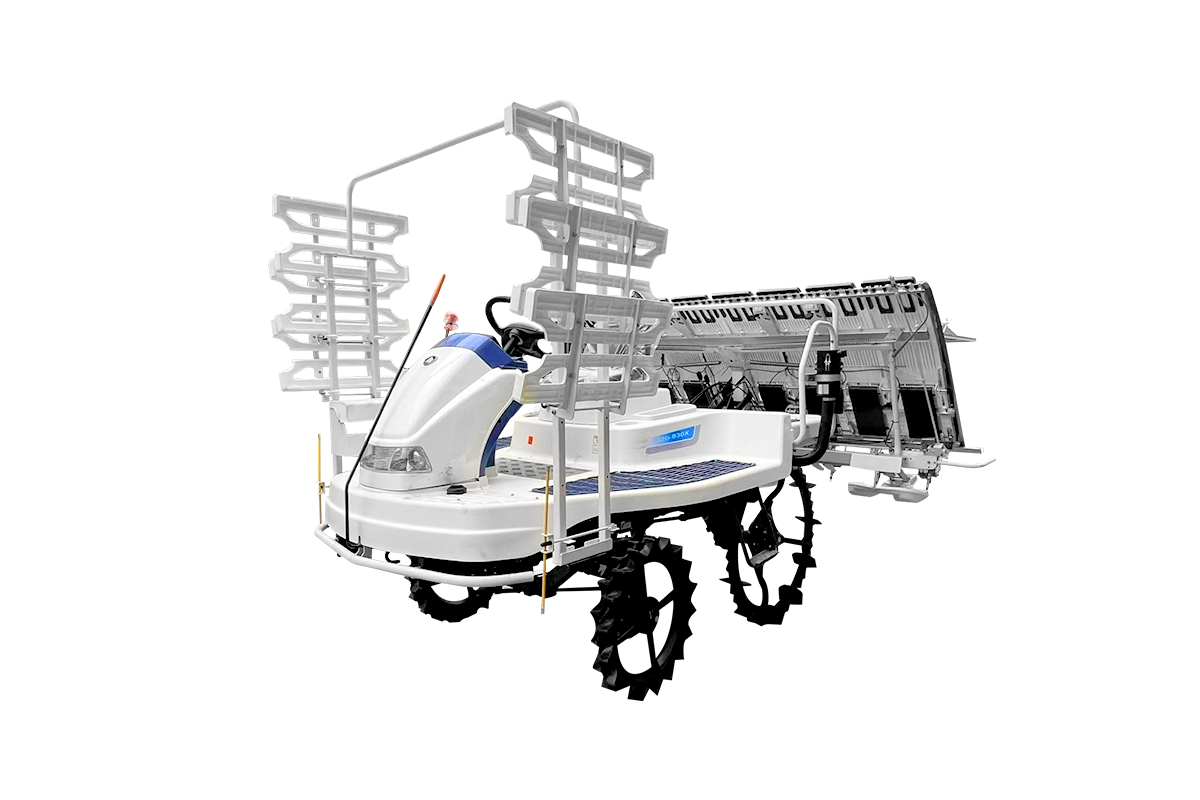
A riding transplanter seats the operator and often one assistant for seedling loading. The machine carries a larger seedling platform, plants more rows per pass, and reduces operator fatigue across a long day. On flat, consolidated fields it delivers the lowest cost per planted hectare.
The trade-off is weight and turning radius. A riding machine needs firm soil, a properly prepared field surface, and headlands wide enough to turn comfortably. Put one on a field with soft, deep mud and the chassis will struggle, the planting depth will drift, and you will blame the machine for a soil preparation problem.
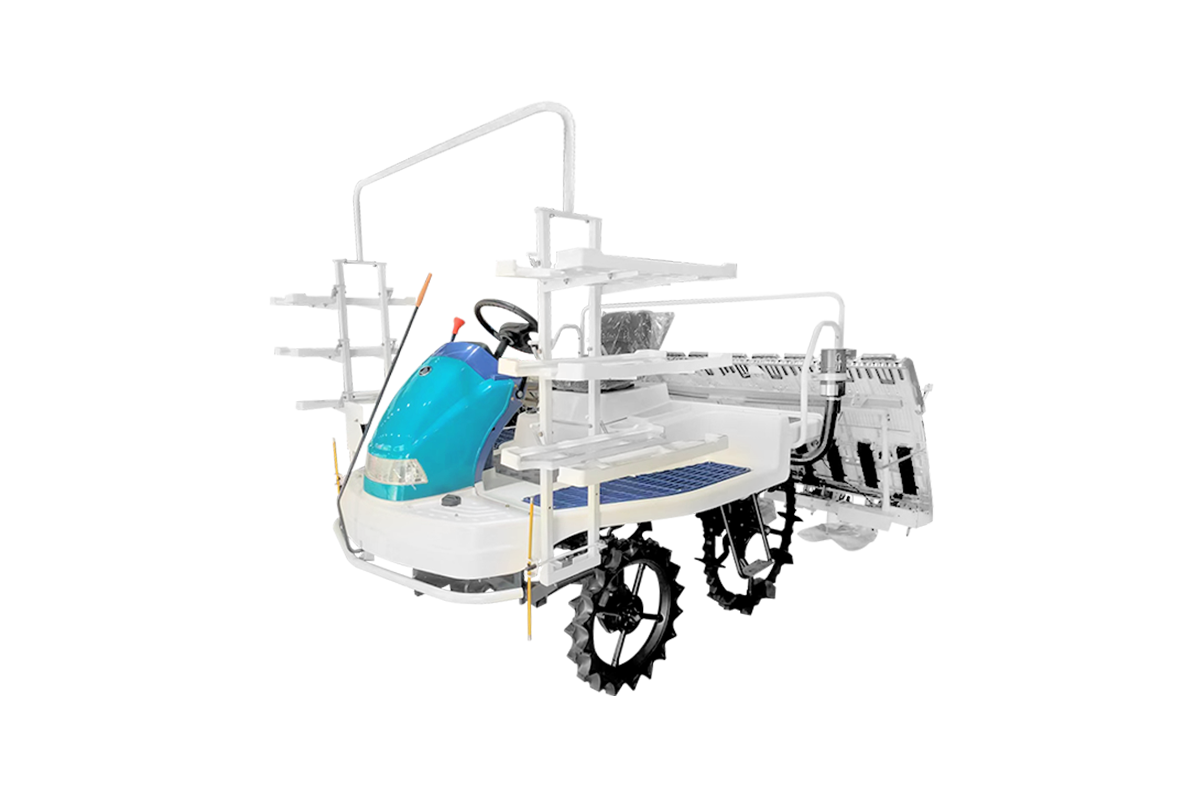 2ZG-1020 Ten-Row Riding Rice TransplanterFor firm, well-prepared fields with adequate headlands, this 10-row riding rice transplanter offers diesel power, four-wheel drive, hydraulic steering, and automatic seedling-box balancing and oil-pressure adjustment.View Product →
Entry-level riding machines usually use mechanical transmission, which is simpler and cheaper to repair. Higher specification machines use hydraulic drive for the planting section, which allows smoother, more consistent planting depth on undulating ground and makes speed adjustment more precise. If your fields vary in mud depth across a single plot, hydraulic drive earns its price difference. If your fields are uniformly firm and flat, mechanical drive does the job at a lower cost.
Six rows is the sweet spot for most commercial family farms. Eight rows suits larger operations and planting contractors. Ten rows is a specialist configuration aimed at very large, uniform blocks, and it only makes sense if you have the seedling logistics and the labour to keep it fed.
There is a real difference between a machine that is fast and a machine that is productive. Speed only converts into hectares when seedling reloading, water management and field preparation keep pace. This is the practical threshold discussed in the comparison of walking versus riding rice transplanters, where the trade-off between purchase price and daily coverage is examined in detail.
The table below summarises how the main configurations behave in practice. Output figures assume well-prepared fields, adequate seedlings and experienced operators. Treat them as planning ranges rather than guarantees, because soil and weather shift the numbers considerably.
| Configuration | Typical Daily Output | People Required | Best Suited To |
|---|---|---|---|
| 2-row handheld | 0.3 to 0.5 ha | 2 | Terraces, tiny plots, trials |
| 4-row walking | 0.8 to 1.2 ha | 2 to 3 | Smallholder farms, soft soil |
| 6-row walking | 1.2 to 1.8 ha | 2 to 3 | Medium plots with firm mud |
| 8-row walking | 1.8 to 2.5 ha | 3 | Larger flat fields, budget conscious |
| 4-row riding | 1.5 to 2 ha | 2 | Compact machines on flat land |
| 6-row riding | 2.5 to 3.5 ha | 2 to 3 | Commercial family farms |
| 8-row riding | 3 to 5 ha | 3 | Contract planting, larger blocks |
| 10-row riding | 5 ha and above | 3 to 4 | Large uniform fields with full logistics |
The most common misreading is to assume the fastest machine is automatically the most profitable. Run the arithmetic on your own farm. If your entire holding is 4 hectares and your planting window is three weeks, a 10-row machine will finish in a day and then sit unused for the rest of the season. A 6-row riding machine used for two or three seasons, or shared with neighbours, usually produces a better return on capital for that scale.
Machines are sold on row count and engine power. They succeed or fail on mud depth and water depth. A transplanter needs the soil to hold the seedling upright at a consistent depth. If the soil is too soft, seedlings tilt. If it is too hard, the planting forks cannot penetrate properly and you get missing hills.
As a working rule, puddled soil settles best when the soft layer is roughly 10 to 20 centimetres deep over firmer subsoil. Deeper than that and walking machines begin to plough rather than float, while riding machines risk sinking at the headland where the soil is most disturbed.
Shallow water, generally a thin film rather than a flood, gives the best visibility for the operator and the most consistent depth control. Fields left under deep water hide the soil surface, and the operator cannot judge whether the seedlings are standing correctly. Drain and re-flood according to the schedule the machine needs, not the schedule that is convenient.
Freshly puddled soil is too soft to plant into. Most growers allow one to three days for the soil to settle, depending on clay content and weather. Planting into unsettled mud is one of the most frequent causes of poor establishment, and no machine specification can compensate for it.
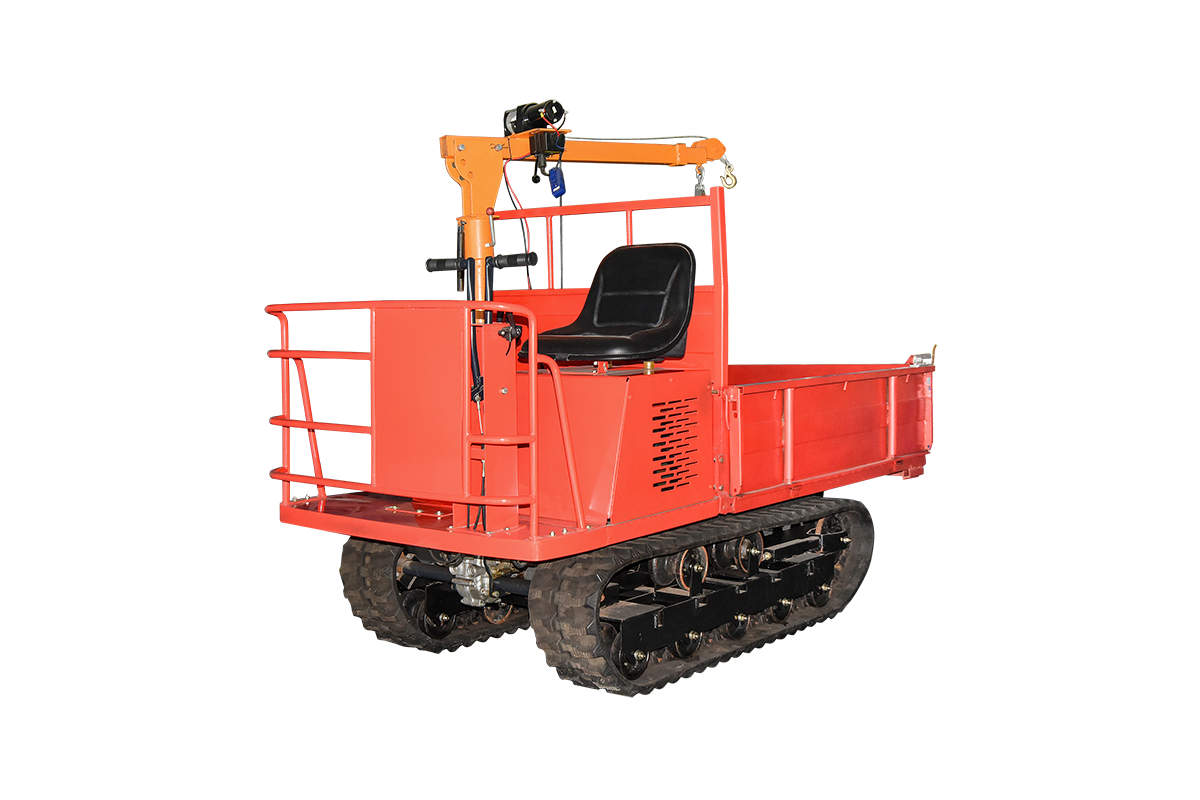
On soft, uneven or wet ground, track-type chassis distribute weight over a larger contact area and reduce the risk of sinking. Wheel-type chassis are lighter, cheaper to maintain and better on firm ground. Match the chassis to the ground you actually have, not the ground you wish you had. The same principle applies to support equipment: the traction behaviour of crawler-type transport vehicles on muddy terrain follows the identical logic, and the same reading of your soil conditions applies.
Purchase price is the smallest part of the story. What matters is the total cost per planted hectare, which combines the purchase price, depreciation, fuel, maintenance, spare parts and the labour needed to keep the machine fed and operating.
The chart below shows a relative comparison of cost per hectare across machine classes, normalised so that the two-row handheld unit equals 100. Lower is better.
Relative cost per planted hectare, handheld two-row unit indexed at 100. Figures reflect labour, fuel and depreciation at typical Southeast Asian conditions and will shift with local wages.
The steep drop between two rows and six rows comes from labour. Manual and handheld planting consume an enormous number of person-days per hectare. Once a machine covers three or four hectares in a day, the labour cost per hectare collapses. After eight rows, the curve flattens, because the machine is no longer the limiting factor: seedling logistics, field preparation and water management are.
After watching hundreds of purchase decisions play out, the same errors appear again and again. Each one is avoidable with a single question asked before the money changes hands.
A wider machine plants faster only if seedlings arrive fast enough. If your nursery produces mats at a rate that supports a four-row machine, an eight-row machine will simply stand still more often. Calculate your daily seedling production before you calculate your row count.
Measure the shortest dimension of your largest plot. If it is under about 40 metres, a wide riding machine will lose a significant proportion of its time to turning. Walking machines tolerate short plots far better.
Two machines with identical row counts can differ enormously in frame strength, transmission quality and spare part availability. A cheap machine with no local parts supply becomes an expensive machine in year two.
Plant one or two plots with the candidate machine before committing to a full-season purchase. Soil, seedling variety and local water practice all affect how a transplanter behaves, and a trial reveals more than any brochure.
Planting quality depends heavily on operator skill. A trained operator on a mid-range machine will outperform an untrained operator on a premium machine every time. Budget for training, not just hardware.
No. A riding machine is faster and less tiring, but it is heavier, needs firm soil and wide headlands, and costs substantially more. On small, soft or fragmented plots, a walking machine often produces a better financial result because it can actually operate where the riding machine cannot.
With good field preparation and steady seedling supply, a two-row handheld unit covers roughly 0.3 to 0.5 hectares, a four-row walking machine 0.8 to 1.2 hectares, a six-row riding machine 2.5 to 3.5 hectares, and an eight-row riding machine 3 to 5 hectares. These are planning ranges, not guarantees.
Generally no. Transplanters are designed to place seedlings into puddled, settled soil at a controlled depth. On dry or sandy ground the planting forks cannot hold depth and seedlings will not stand. For those conditions, a rice seeder is the appropriate machine.
Most rice transplanters offer a fixed row spacing in the region of 25 to 30 centimetres, with hill spacing selectable within a set of standard positions. Confirm that the available settings can deliver the plant density your local agronomy guidance recommends.
Shallow planting is usually preferred, typically in the range of 1.5 to 3 centimetres of soil covering the root zone, adjusted for seedling size and soil condition. Deeper planting delays tillering; shallower planting risks floating seedlings when water rises.
With routine maintenance, cleaning after each season, and timely replacement of pickup forks, belts and worn bearings, a well-built machine can serve for many seasons. Frame and transmission quality, plus local spare part availability, determine the realistic service life more than any single specification.
Yes, in most cases. Rice and vegetable seedlings differ in shape, root structure and required planting depth. A dedicated vegetable transplanter designed for the crop gives far better results than attempting to adapt a rice machine.
Ask for the exact tray specification, the adjustable hill spacing positions, the planting depth range, the recommended soil and mud conditions, the list of consumable parts and their replacement intervals, and whether the model is supported with spare parts in your region. A supplier who can answer all six is a supplier worth buying from.
Before signing anything, run down this list. It takes twenty minutes and prevents most of the regret that follows a rushed purchase.
If you are still narrowing the field, a useful next step is to read how machine choice feeds directly into yield outcomes, as covered in the analysis of which rice transplanter machine can maximise yield. Yield, not speed, is what ultimately pays for the machine.
Zhejiang Xiaojing Agricultural Machinery has been manufacturing rice transplanters since 2006, with a product range covering handheld, walking and riding configurations from two rows to ten rows, alongside seeders, transplanters for vegetables and tobacco, tea pruning machines, crawler transport vehicles and remote-control spraying equipment. The range is built around one idea that has not changed since the company began: match the machine to the field, not the field to the machine.

 Custom Agricultural Equipment Manufacturers